



Shute Shield: 2015 Season Review – Northern Suburbs
by Paul Cook –
Continuing our build-up to the new Shute Shield season that kicks off on March 19th, here’s the next of our 2015 season reviews – Northern Suburbs.
An 11th place finish in 2014 was a fairly rapid fall from grace for Norths following their semi-final appearance only two years earlier. Tasked with restoring the Shoremen to the upper reaches of the ladder while fostering strength across the club was fledgling head coach, Simon Cron.
Having served his apprenticeship with Sevens and as part of a co-coaching ticket at Eastern Suburbs, it was the Kiwi’s chance to unleash his own brand of rugby know-how, and despite missing out on his stated aim of finals football in year one, the holistic advances made throughout the grades at North Sydney Oval were obvious and his award for Shute Shield Coach of the Year was a clear indication that his work had been noticed.
But as Rugby News found out recently, as far as the aspirational Cron is concerned, it was still a year of underachievement.
*************************************
Give us a brief overview of the season from your perspective?
Simon Cron: “I felt disappointed with the end result and that’s because we lost three games by a point, one by two points and another by four points – and in all of them we were up. You look at the World Cup and teams with the experience to shut out games, we had very little in our team and in terms of knowledge, we’re still growing leaders.”
But considering the team improved three ladder positions and almost doubled the points tally from the previous season, there must have been plenty of positives?
“There were. The type of rugby we played was certainly a positive, it was quite expansive. We had a massive focus in the off-season last year on ball skills because we wanted to play, and for the most part, we did. However, there were things that let us down statistically but in terms of the game, are very fixable and blatantly obvious.”
The side started off in fine fashion with four wins from your first five matches, only to lose six of the next seven. Does that say more about the draw and who you played against than it does about the consistency of a young side?
“No, we should have won the first five and not had those six losses in a row – we should have capitalised on our opportunities to beat Manly at home and never should have let the lead go against Souths for example. Like every team in the competition we lost some key players to injury and they all seemed to be in the same positions, but also we still had some coaching to do in terms of the depth of the squad.”
Norths scored over 100 more points than Randwick and West Harbour, who both finished above you on the ladder, but conceded more than Gordon, who finished behind you in 9th. Do those stats tell their own story?
“Yes it does. Of those matches we lost by a point, we had some game management issues and made some poor decisions which the boys learnt from, including a few unforced errors that led to tries against us. We also missed a number of conversions, had problems with our exits and there was a very high percentage of missed tackles in a couple of very key positions that made it a lot harder for us to win games. A number of our players were amazing in defence with the amount of tackles they were making, but they were tackles they shouldn’t have had to make.”
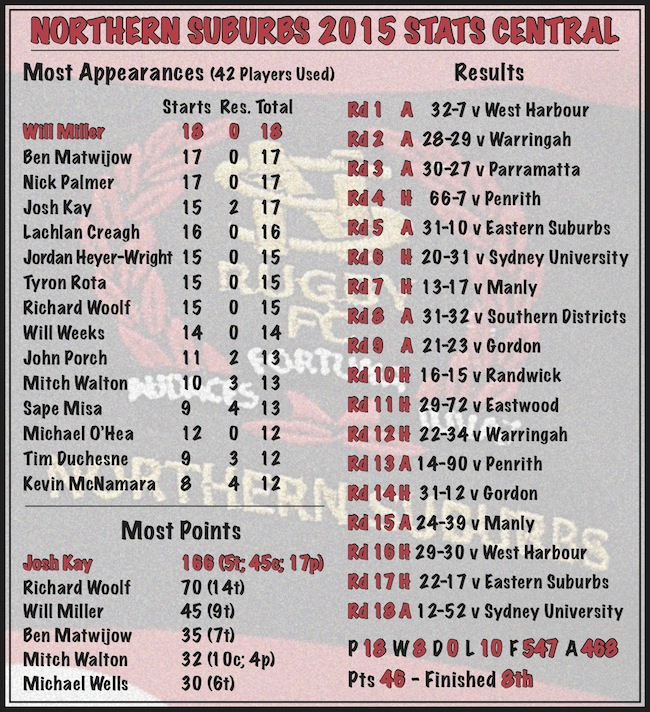
Of the 11 games played against the seven teams that finished above you, you won just the two, against Randwick and West Harbour. Is that consistency against your fellow challengers the great leap forward that’s needed in 2016 if you’re to challenge for finals and maybe beyond?
“Yes, and to take it I think we need to improve our game management and our rugby brains. Some of the knowledge around what to do in certain scenarios is a massive learning curve for our boys.”
In reference to your approach to the coaching role at Norths before a ball was kicked in 2015, you told Rugby News that you could “be a full-time recruiter and have great teams but ultimately, there’s no longevity to that as a club, it’s a very short-term approach and it can be a cycle that is difficult to get out of.” You blooded a lot of young players during the season, which will build strength in depth in the years ahead, but can come at an initial cost. Has that been a difficult trade-off?
“Initially it’s challenging, especially when you lose players in key positions, but I stand by that comment 100%. The reason why – and I’ll give you an overall club perspective – is that when I came on board towards the end of 2014, my biggest issue was meeting with 3rd and 4th grade players who had lost the will to play rugby. At the end of the previous season, Norths had battled to get 3rd and 4th grade teams on the field and they had key stalwarts of the club making phone calls on Thursday nights just to get a team together. Players had lost the fun, they weren’t enjoying their rugby and they were leaving.
“By the end of last season, both those grades got into the finals and the hardest part was telling players they couldn’t play because we had too many, so I don’t regret one coffee that I had with them to talk them into staying. In terms of the cultural shift within the club, that’s massive for us, and that has to start with those grades.
“This year there are a lot of new faces coming to training and it’s brilliant because the positive word of mouth from our players is bringing guys back into the game. We will definitely recruit in a couple of key positions where we lack depth or guys have retired, and we are down on numbers. But so far, the majority of new players are just guys showing up or emailing to ask where training is. It’s really handy when guys choose to come along and jump in as it adds competition for spots and also improves training intensity.”
In terms of your tactical approach you said that you felt Norths “…have been a little predictable in their forward attacking patterns and therefore, it’s been easy to get line speed on them, so, for us this year, it’s about making the opposition defence think.” Do you think you achieved that?
“Definitely. At one stage in the year, our forwards were outscoring our backs and that’s because we have some serious athletes up front and also because we got gain line control in the forwards. Our biggest let down in terms of our strike play, was execution, which was potentially down to a couple of areas where we lacked strength in depth. Those strike plays are quite important in terms of our pattern set-ups and we started to commit some basic errors and lost the ability to control that first-phase ruck as much as we would have liked to, and that impacted on us a bit. Our forward attacking shapes were good, and in those five teams across the club that did make their relevant finals, you could see the same shapes happening, which was a really positive outcome.”
You’ve told me that you’re a winner by nature and you refuse to accept second best. So, in spite of the obvious progress, how did finishing 8th sit with you in the cold light of day?
“Not well! Look, we made huge progress but winning matters and I’ll give you an anecdote to help explain that, because it gave me an insight into something that’s maybe evolved over time at Norths that I’ve got to smack on the head.
“We put ourselves in a position to beat Manly in round seven, we had opportunities to take that game but we made a couple of poor decisions that cost us a couple of tries. However, I sat in the sheds at full-time and looked around and while there were a few guys battered and bruised and bleeding from every orifice, there were a few others having a bit of a laugh and a giggle – only a few minutes after that loss. It dawned on me that they were patting themselves on the back for being close, that they were happy to be narrow losers to one of the best teams in the comp.
“I shelved it at the time but I dealt with it at training the following week and made it very clear to the team that patting yourself on the back for being close is unacceptable. You’ve got to grow winners and that’s part of the sports psychology of being a winner. I coached Brumbies’ scrumhalf Michael Dowsett a lot in my first stint at the club as skills coach and in charge of the Sevens program, and I caught up with him during the year. He came to training one night and just reminded the boys that you could play a brilliant game but if the team loses it means nothing. He was emphasising the difference between individuals playing for themselves and a team playing for each other. ‘Dows’ understood the difference and that’s exactly what I’m trying to push onto our boys now. If I’m not going to sleep because we lost, they shouldn’t!”
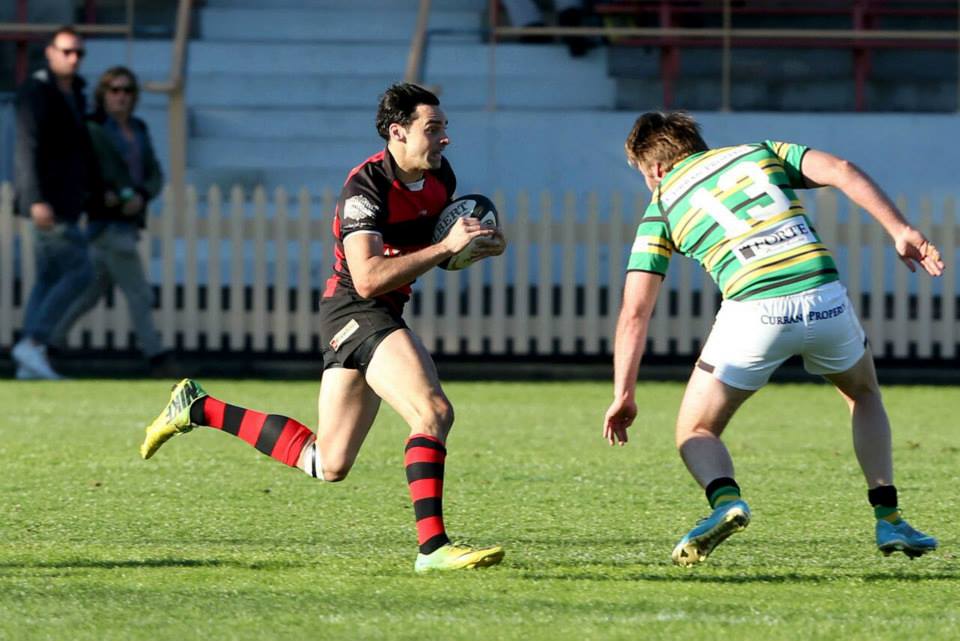
Richard Woolf bagged 14 tries and a spot in the North Harbour Rays squad in a stellar season
You won Shute Shield Coach of the Year, an award voted for by your peers, so you must be doing something right?!?
“I think that maybe that’s a reflection of the club as a whole but it’s an absolute privilege to have been voted by the other coaches, no doubt. It’s humbling. However, I would have swapped it for a place in the finals!”
As you’ve mentioned, a look across the club as a whole shows that while 1’s and 2’s were outside the top six, 3’s, 4’s and all three colts side made finals footy. A great sign of better things to come?
“Five of our seven sides made the finals, which is good but that’s not acceptable to me either, I want all of them in it. What I would say is that I think there’s a massively different external perception about our club at the moment – I believe. I think there was a bit of a negative perception about the playing group or the club in recent years and I think that’s changed, and that’s helping us to attract players and retain players through word of mouth. The boys within our club have led that change etc., so we’re on the right track.”
Player of the Year?
“Will Miller. He’d have to be one of the toughest players in Shute Shield and is second to no-one when he runs on that field. The boys recognise that but he is also humble and constantly wanting to work on his game.”
Rookie/s of the Year?
“We didn’t actually have one in our end-of-season awards but you’d be looking at Lochie Creagh, John Porch and Hugh Sinclair. They all showed huge work rates and are guys you can rely on when the going gets tough. Each of them added to the squad environment on and off the pitch.”
Most Improved Player of the Year?
“Nick Palmer. He was playing 3rd grade the year before and touches in 1st grade but came in and was excellent and went on to play for the NSW Country Eagles in the NRC and also the Aussie Barbarians. He’s very coachable and he’s potential Super Rugby this kid.”
Players recognised at the next level:
Ben Matwijow (Canterbury, ITM Cup & Queensland Reds); Michael Wells (ACT Brumbies); Tim Duchesne (Northampton Saints, UK); John Porch (North Harbour Rays, NRC & Aussie Sevens); Jordan Heyer-Wright (Greater Sydney Rams, NRC & Brumbies Training Program); Nick Palmer (NSW Country Eagles, NRC & Aussie Barbarians); Lawrance Hunting (North Harbour Rays, NRC); Will Miller (NSW Country Eagles, NRC); Hugh Sinclair (North Harbour Rays, NRC); Richard Woolf (North Harbour Rays, NRC)